




Busch Stadium
MLB-Grade Installation
| Client | St Louis Cardinals |
| Type | MLB Baseball Stadium |
| Year | 2016 |
| Size | 110,000 Sq Ft |
| Location | St Louis, MO |
| Services | Comprehensive full-field optimization — subsurface assessment, drainage repair, irrigation overhaul, rootzone re-engineering, 3-D-controlled grading, and resurfacing |
| Turf System | Sand-based natural grass sod cut to a 1-inch profile, on a fully reconstructed 10-inch engineered rootzone over a 4-inch pea gravel layer, with 4-oz geotextile separation above the prepared subgrade |
| Status | Complete |
The St. Louis Cardinals’ grounds team is widely regarded as among the best in Major League Baseball. By late 2016, their playing surface at Busch Stadium had accumulated 11 years of issues that no longer matched the standard the field needed to perform to. The rootzone had become hydrophobic and was holding standing water after rain. The irrigation system was missing head-to-head coverage and suffering pressure fluctuations. The infield and foul-territory slope was washing out the warning track. The warning-track edges were asymmetric and no longer matched the outfield wall. The Cardinals engaged Bush Turf for a comprehensive renovation — what Steve Bush described in his own write-up of the project as the equivalent of upgrading the field “from ‘iPhone 4’ status to ‘iPhone 7’ capabilities.” The project also had to be sequenced around Busch Stadium’s hosting of the 2017 NHL Winter Classic.
Project Overview
Project Name
St Louis Cardinals Busch Field Optimization
Client Background
The St. Louis Cardinals are one of Major League Baseball’s most successful franchises. Busch Stadium opened in 2006, and by late 2016 the playing surface had accumulated 11 years of issues affecting playability and maintainability. The Cardinals’ grounds and operations team — head groundskeeper Bill Findley, assistant groundskeeper Justin Scott, and head of operations Joe Abernathy — set the renovation priorities and worked alongside Bush Turf throughout. The project was timed to align with the venue’s January 2, 2017 hosting of the NHL Winter Classic between the Chicago Blackhawks and St. Louis Blues.
Objective
Modernize Busch Stadium’s playing surface end-to-end — addressing rootzone failure, irrigation inconsistencies, infield and foul-territory grading, and warning-track asymmetry — while integrating current-generation materials, control technology, and field-mapping and grading equipment. Sequence the work to allow the venue to host the 2017 NHL Winter Classic mid-renovation on a protected surface and to deliver a season-ready field for the 2017 Cardinals home opener.
Scope
Pre-renovation in-season Ground Penetrating Radar (GPR) survey; 3-D field design via Topcon Robotic Total Station; field demolition (5 days, nearly 400 truckloads of material hauled off site); drainage system inspection, repair, and SubAir line preparation; complete irrigation system overhaul (line sizing, valve bank, booster station, cloud control, permanent moisture sensing); rootzone engineering with consultant Norm Hummel and multi-lab cross-testing; DuraEdge infield material harvest and reinstall; subgrade preparation; pea gravel installation; rootzone installation; 3-D-controlled grading at every layer; geotextile installation for subgrade separation and Winter Classic moisture retention; final sand-based sod installation.
Key Details
The project’s technical backbone was the pairing of in-season GPR subsurface mapping with 3-D Robotic Total Station design and grading control. The GPR survey was conducted while the field remained in regular MLB use, generating 3-D imagery to a depth of 4.75 feet that revealed rootzone depths varying from 9–14 inches across the field, settled drain lines, and locations of all subsurface infrastructure. The Total Station carried that data through design, demolition, and grading — every point on the field had x, y, and z coordinates, and the same design file can now be reloaded for future repairs or post-event regrading. The rootzone itself was custom-engineered: a 90/10 Dakota Peat / classified-sand mix produced by Madison County Sand, achieving a 2.6 uniformity coefficient and a 22 in/hr infiltration rate. The renovation also reused valuable existing material (DuraEdge engineered infield soil) rather than replacing it.
Timeline
In-season GPR survey during the 2016 season; design, sourcing, and rootzone engineering pre-mobilization; on-site rebuild beginning post-2016 season; staged completion through the January 2, 2017 NHL Winter Classic; final touches and sodding in late February 2017. Total active project window approximately 4–5 months.
Equipment Deployed
Ground Penetrating Radar (GPR) for non-disruptive subsurface mapping; Topcon Robotic Total Station with handheld rover for 3-D design, layout, and grading verification; 3-D-controlled box blade integrated with the grading tractor’s onboard computer; excavators and dump carts for demolition; concrete saws for breaking up legacy foundation pieces of the original Busch Stadium; carbide-toothed trencher for cutting irrigation lines through subgrade obstructions. Specified materials and systems included Hunter I-40, I-20, and MP Rotator irrigation heads, Hunter brass valves, a Watertronics Booster station with variable frequency drive, a Baseline Base station 1000-control system (cloud-based), 12 permanent moisture sensors, the Madison County Sand 90/10 rootzone, Dakota Peat, DuraEdge engineered infield soil, and 4-oz and 6-oz geotextiles.
Construction Strategy and Implementation
Concept and Vision
The vision for this project was straightforward in framing but ambitious in scope: take a Major League Baseball playing surface that had been performing at the level expected of a modern MLB venue when it opened in 2006, and bring it up to the level expected eleven years later. That meant rebuilding the field from the rootzone up, not just resurfacing the top. Bush Turf’s approach started below the grass — a non-disruptive Ground Penetrating Radar survey conducted during the Cardinals’ season, capturing subsurface conditions to a depth of 4.75 feet without taking the field offline. That data, combined with the wish list from the Cardinals’ grounds and operations team, drove the design that ran through Topcon Robotic Total Station equipment for the rest of the project. The defining features of the renovation were GPR-driven subsurface assessment, 3-D Total Station design and grading control, an engineered 90/10 rootzone built and verified with consultant Norm Hummel and multi-lab testing, a fully overhauled cloud-controlled irrigation system with permanent moisture sensing, and a project sequence built to host the 2017 NHL Winter Classic mid-renovation on a protected surface.
Project Philosophy
Bush Turf’s philosophy across renovations is that great fields are built from the ground up — literally. The surface is only as good as the rootzone, which is only as good as the gravel layer, which is only as good as the subgrade and drainage that sit beneath it. On the Busch Stadium project, that philosophy translated into refusing to settle for like-for-like replacement of any layer where data showed an opportunity to do better. Rootzone failure was diagnosed and re-engineered with multi-lab cross-testing. Irrigation lines that the design calculations showed should have been larger were sized up. Grading inconsistencies were corrected with 3-D-controlled grading rather than approximated using traditional 2-D laser methods. And the existing engineered infield soil was harvested and reinstalled rather than discarded — preserving what was working while rebuilding what wasn’t. The result is a surface engineered to play better than the one it replaced, on systems built to be maintained, monitored, and repeated.
Execution
Phase 1 — In-Season GPR Survey (During 2016 Cardinals Season)
With the field still in regular MLB use, Bush Turf conducted a non-disruptive Ground Penetrating Radar survey of the entire playing surface. The GPR generated 3-D imaging to a depth of 4.75 feet, identifying drainage tile and trench locations, rootzone depths varying from 9 to 14 inches across the field, varying pea gravel depths, settled drain lines requiring repair, areas holding water, and the precise locations of all irrigation lines. This data became the foundation for every design decision that followed and made it possible to remove the field without disturbing more of the subgrade than necessary.
Phase 2 — Design, Sourcing, and Rootzone Engineering
Bush Turf worked with consultant Norm Hummel and the Cardinals’ grounds team on the design. Suppliers were contacted, samples were collected, and rootzone candidates were tested across multiple labs to compare and verify results. After several rounds of testing and elimination, the team specified a 90/10 rootzone produced by Madison County Sand — a Dakota Peat blend with two classified sands run together — delivering a uniformity coefficient of 2.6 and an infiltration rate of 22 inches per hour. Field design was executed in 3-D using a Topcon Robotic Total Station, including lowering the infield by 4 inches and bringing the warning track to a single uniform elevation around the entire field.
Phase 3 — Demolition (Post-2016 Season)
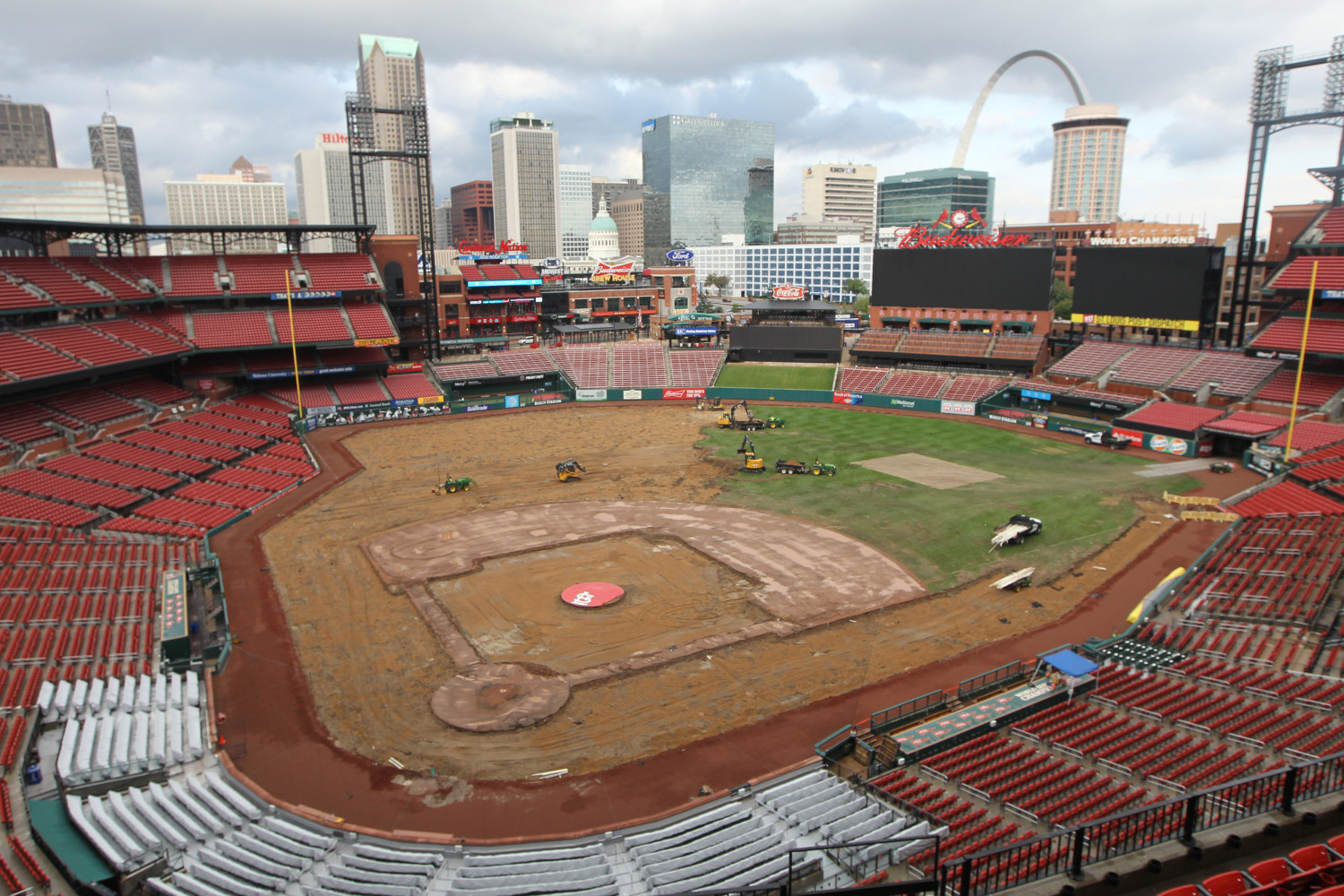
Once the Cardinals’ 2016 season ended, Bush Turf mobilized for demolition. Excavators and dump carts removed the field while crews stayed on top of the old surface to protect the underlying drainage system and subgrade. The Total Station established subgrade elevations during excavation. In some areas, remaining pieces of the original Busch Stadium foundation had to be broken up using concrete saws and excavators to reach the correct depth. The DuraEdge engineered infield soil was harvested and stockpiled during demolition for later reinstall. Demolition took 5 days, with nearly 400 loads of material hauled off site.
Phase 4 — Drainage Repair and Irrigation Overhaul
Areas the GPR had flagged as potential problems were addressed: settled drain lines were raised and lines without positive flow to collectors were removed and reinstalled. Connections to the stadium’s existing (currently nonfunctional) SubAir system were checked and lines repaired to facilitate future use. The Total Station Rover documented all repairs. The irrigation system was completely upgraded — lines from the in-stadium valve bank were increased from 2 inches to 2.5 and 3 inches, new Hunter I-40 opposing-nozzle adjustable stainless heads were installed throughout the outfield, Hunter stainless I-20s were installed on the sidelines, Hunter MP Rotators were placed around home plate and the warning track for precision watering and dust control, a 3-inch supply line and Hunter brass valves were installed at the valve bank, a Watertronics Booster station with variable frequency drive was added to eliminate pressure fluctuations, and a Baseline Base station 1000-control system was installed for cloud-based monitoring and operation, supported by 12 permanent moisture sensors distributed across the infield, outfield, and sidelines.
Phase 5 — Subgrade, Gravel, and Rootzone Installation
With drainage and irrigation installed, the team brought the subgrade to-grade using the Total Station. A 4-oz geotextile was laid to prevent subgrade contamination of the gravel. With the Total Station system, each layer could be graded by simply offsetting the same design file: 4 inches up to grade the gravel layer, then 10 inches up to grade the rootzone surface — every layer perfectly reflecting the one below. Pea gravel was installed at a 4-inch depth. The 90/10 rootzone was installed at a 10-inch depth, with the irrigation system run continuously to moisturize and firm the rootzone in place. Irrigation heads were set to-grade using the Total Station Rover.
Phase 6 — NHL Winter Classic (January 2, 2017)
With the rootzone in place but final sodding still pending, a 6-oz white geotextile was installed to retain moisture and stabilize the sand rootzone through the NHL Winter Classic event window. Busch Stadium hosted the Chicago Blackhawks and the St. Louis Blues on January 2, 2017 on the protected surface. After the event, the geotextile was removed and the project resumed.
Phase 7 — Final Grading and Sodding (Late February 2017)
Final touches were put on the field in late February. The DuraEdge infield material harvested during demolition was reinstalled, with new material worked into the old. Sand-based sod cut to a 1-inch profile was installed to complete the surface, ready for the Cardinals’ 2017 home schedule. The completed Total Station design file was retained for future use — for any future renovations, repairs, or post-event grading, the same file can be loaded into a grading tractor to restore any point on the field to its designed elevation.
Results and Acknowledgments
The renovation delivered a fully reconstructed Busch Stadium playing surface — rootzone, drainage, irrigation, grading, and turf — engineered to current-generation standards and ready for the Cardinals’ 2017 season. The new 90/10 rootzone, with a 2.6 uniformity coefficient and 22 in/hr infiltration rate, replaced an aging hydrophobic surface that had been holding water after rain. The rebuilt irrigation system, now correctly sized and equipped with cloud-based control and 12 permanent moisture sensors, gave the Cardinals’ grounds team granular monitoring and operation from any device. The 3-D Total Station design file remains available to drive future grading, post-event repairs, or planned renovations to a millimeter-accurate restoration. The project was sequenced successfully around the venue’s January 2, 2017 hosting of the NHL Winter Classic, delivering both the event and the renovation without compromising either.
Bush Turf gratefully acknowledges the partnership of the St. Louis Cardinals organization, especially head groundskeeper Bill Findley, assistant groundskeeper Justin Scott, and head of operations Joe Abernathy, whose deep field expertise and clear renovation priorities shaped every decision on the project. Thanks also to consultant Norm Hummel for design and test-data leadership on the rootzone, and to the project’s material and technology partners — Madison County Sand, Dakota Peat, DuraEdge, Hunter Industries, Watertronics, and Baseline — for making the specified performance possible. The Bush Turf team takes pride in this project as a defining example of full-stack field renovation built on subsurface science, 3-D design, and engineered materials.

Challenge vs. Solution

11 Years of Wear. A Winter Classic in the Window. A Full-Stack Rebuild.
Bush Turf had to renovate Busch Stadium end-to-end — rootzone, drainage, irrigation, grading, and surface — addressing eleven years of accumulated issues, while sequencing the work around the venue’s January 2, 2017 hosting of the NHL Winter Classic and the Cardinals’ 2017 home opener.

Hydrophobic rootzone — sand failing, infiltration low, standing water after rain
Irrigation lacking head-to-head coverage with unpredictable pressure fluctuations
Infield and foul-territory slope causing runoff that washed out the warning track
Asymmetric warning-track edges no longer matching the outfield wall
Tight project window — work could not start until the 2016 Cardinals season ended
NHL Winter Classic on Jan. 2, 2017 had to be played mid-renovation on protected field
GPR-Mapped, 3-D-Engineered, Full-Stack Renovation.
Bush Turf executed a full-stack rebuild — rootzone up, irrigation in, surface down — driven by an in-season GPR subsurface survey and a Topcon Robotic Total Station design that controlled grading to millimeter accuracy across every layer of the field.

In-season GPR survey mapped subsurface to 4.75 ft without disrupting MLB play
Topcon 3-D Total Station drove design, demolition, and grading to spec
Engineered 90/10 rootzone — 2.6 uniformity coefficient, 22 in/hr infiltration
Complete irrigation overhaul — sized lines, Hunter heads, cloud control, sensors
6-oz geotextile staged the field through the NHL Winter Classic event window
Sand-based sod (1-inch profile) finished the surface for the 2017 Cardinals season
The Work, Up Close


TESTIMONIALS
From The Client

“Lorem ipsum dolor sit amet, consectetur adipiscing elit, sed do eiusmod tempor incididunt ut labore et dolore magna aliqua. Ut enim ad minim veniam, quis nostrud exercitation ullamco laboris nisi ut aliquip ex ea commodo consequat. Duis aute irure dolor in reprehenderit in voluptate velit esse cillum dolore eu fugiat nulla pariatur. Excepteur sint occaecat cupidatat non proident, sunt in culpa qui officia deserunt mollit anim id est laborum.””

Bill Findley
Groundskeeper — St, Louis Cardinals Busch Stadium, St Louis MO
Recent Projects