




Wrigley Field
MLB-Grade Installation
| Client | Chicago Cubs |
| Type | MLB Baseball Stadium |
| Year | 2010 |
| Size | 100,000 Sq Ft |
| Location | Chicago, IL |
| Services | Full playing surface reconstruction |
| Turf System | Natural grass sod across the entire infield and outfield, with a clay-amended infield mix engineered for improved playing performance |
| Status | Complete |
In November 2010, Wrigley Field hosted its first college football game since 1938 — the 104th meeting between the University of Illinois and Northwestern University. With a heavy sod overlay still covering the infield and the 2011 Chicago Cubs season already on the calendar, Bush Sports Turf was contracted to fully rebuild Wrigley’s playing surface. The job: restore the historic field’s exact geometry to millimeter accuracy, scientifically upgrade the infield, and deliver a season-ready ballpark in under two weeks of late-fall Chicago weather.
Project Overview
Project Name
Wrigley Field Playing Surface Rebuild
Client Background
Wrigley Field, opened in 1914, is one of the most storied venues in American sports and the home of the Chicago Cubs. The November 2010 Illinois–Northwestern matchup was Wrigley’s first college football game since 1938 and its first football game of any kind since the Chicago Bears departed in December 1970. A full playing-surface rebuild for the 2011 Cubs season was already on the team’s calendar; the football game preceded that planned reconstruction. Roger Baird, the Cubs’ head groundskeeper, led the project on the team’s side and had a long-standing working relationship with Bush Sports Turf.
Objective
Rebuild Wrigley Field’s playing surface to better-than-original condition for the 2011 Cubs season — restoring the historic field’s exact geometry (bases, baselines, irrigation) with millimeter accuracy while taking the opportunity to scientifically upgrade the infield mix, all inside a tight late-November weather window.
Scope
Pre-football mapping of the original field surface and all baseball-specific features; infield soil testing and analysis; removal of the football-conversion sod overlay; full teardown of the prior baseball surface; clay amendment integrated into a new infield mix based on soil analysis; precision regrading via GPS-mapped data and laser-guided equipment; new sod installation across the entire infield and outfield; restoration of the historic field geometry to millimeter accuracy; phased delivery (infield first, outfield the following week) to manage weather constraints.
Key Details
Bush Sports Turf’s pre-conversion field mapping was the operational backbone of the entire project — the team digitally captured the exact location of every base, baseline, irrigation point, and grading detail before the football overlay was installed, then used that file to drive the rebuild. The infield was upgraded, not simply replicated: soil analysis led to a clay-amended infield mix designed to play better than the surface it replaced. Owner Steve Bush summarized the deliverable at the time: the field was put back exactly as it had been, “only in better shape.”
- Timeline: Pre-conversion mapping completed before November 20, 2010; on-site rebuild began Monday of Thanksgiving week (November 22, 2010); total active project window under two weeks
- Specialized equipment deployed: Sophisticated field-mapping and GPS-based grading equipment, laser-guided grading tools, soil testing and analysis equipment, and standard sod installation equipment. The articles describing the project emphasize that Bush’s field-mapping and grading technology was a primary reason the Cubs selected the company for the rebuild.
- Project value: Confidential per client agreement
Construction Strategy and Implementation
Concept and Vision
The vision for this project started with a simple commitment: when the Cubs walked back onto Wrigley Field for the 2011 season, the geometry of the diamond — every base, every baseline, every irrigation point — would be exactly where it had always been, only on a better-engineered surface. To deliver that, Bush Sports Turf treated pre-conversion field mapping as the foundation of the entire project. Before the football overlay was even installed for the Illinois–Northwestern game, the Bush crew was on site with field-mapping equipment, capturing the historic surface as a digital file that would later drive GPS- and laser-controlled grading equipment. The defining features of the project were pre-conversion GPS field mapping, infield soil analysis that drove a clay-amended infield upgrade, and phased delivery sequenced to beat the late-November freeze.
Project Philosophy & Key Features
For Bush Sports Turf, working at a venue like Wrigley means two non-negotiables: respect the history, and leave it better than you found it. The historic-site requirement drove the millimeter-accuracy mapping discipline — nothing about how the field looked or played could shift relative to the original layout. The “better than you found it” principle drove the infield soil analysis and the clay amendment — an upgrade the team identified by testing the existing infield mix and engineering an improvement into the new install. Bush approaches every renovation this way: rebuild to spec, and also bring scientific judgment and field-mapping technology that allow the new surface to play better than the one it replaces.
Execution
Phase 1 — Pre-Conversion Field Mapping (Prior to November 20, 2010)
Before Wrigley Field was converted for the Illinois–Northwestern football game, the Bush Sports Turf crew was on site with GPS field-mapping equipment to digitally capture the exact location of every base, baseline, irrigation point, and grading detail on the historic playing surface. That digital file became the master reference for the rebuild. In parallel, the team conducted soil analysis on the infield to determine whether the existing mix should be replicated or improved.
Phase 2 — Football Overlay and Match Day (November 20, 2010)
A heavy sod overlay was installed across the infield to enable the football conversion. Illinois defeated Northwestern 48-27 in the 104th meeting between the two schools — Wrigley’s first college football game since 1938 and its first football game of any kind since the Chicago Bears’ final season at the ballpark in 1970.
Phase 3 — Demolition and Site Preparation (Monday of Thanksgiving Week, November 22, 2010)
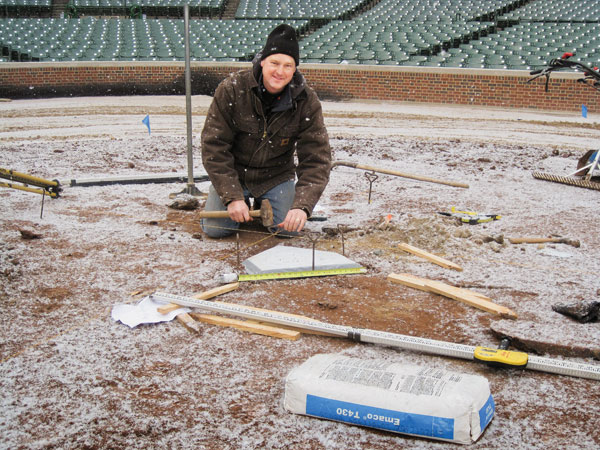
Bush crews mobilized at Wrigley on the Monday of Thanksgiving week. The football conversion sod was removed, and the prior baseball surface was taken down to enable a full rebuild. Owner Steve Bush noted that dirt work had to be completed before sustained freezing temperatures arrived — daytime highs were in the 30s and nighttime lows were in the teens during the project window.
Phase 4 — Infield Reconstruction
With the pre-conversion digital field map loaded into GPS- and laser-guided grading equipment, the Bush team rebuilt the infield to its historic geometry — millimeter-accurate replication of bases, baselines, and grading. Based on the soil analysis from Phase 1, clay material was integrated into the new infield mix to deliver a better-playing surface than the one that came off. New sod was installed across the rebuilt infield. Infield reconstruction was complete approximately one week into the project.
Phase 5 — Outfield Reconstruction
The outfield rebuild followed in the second week, completing the playing surface ahead of the 2011 Cubs season. Throughout the project, the team worked through snow, ice, and shifting late-November weather windows.

Results and Acknowledgments
The project delivered a fully rebuilt Wrigley Field playing surface in under two weeks of late-November Chicago weather — geometry preserved, infield scientifically upgraded, season-ready in advance of the 2011 Cubs schedule. Pre-conversion GPS field mapping and laser-guided grading allowed the Bush crew to replicate Wrigley’s historic field layout to millimeter accuracy — an essential requirement at a venue that has been in continuous use since 1914. The infield soil analysis and clay-amended mix delivered the additional value Steve Bush summarized at the time: the field was put back exactly as it had been, only in better shape.
The Wrigley Field rebuild capped a body of work at premier venues including Dodger Stadium (renovated for the World Baseball Classic), Iowa State University’s Jack Trice Stadium, the University of Iowa’s Kinnick Stadium, Modern Woodmen Park, and TPC Deere Run, and reinforced Bush Sports Turf’s reputation for high-precision field-mapping and grading at historic sites.
Bush Sports Turf gratefully acknowledges the partnership of the Chicago Cubs organization, and in particular Roger Baird, the team’s head groundskeeper, whose long-standing collaboration with Bush set the foundation for the project.

Challenge vs. Solution

A Historic Field. A Two-Week Window. A Chicago Winter.
Bush Sports Turf had less than two weeks of late-November weather to remove a football conversion overlay, tear down the existing baseball surface, scientifically upgrade the infield, and rebuild Wrigley Field — geometry, irrigation, and all — in time for the 2011 Cubs season.

First college football game at Wrigley since 1938 left a heavy sod overlay on infield
Full rebuild required removing football overlay AND prior baseball surface
Historic-site geometry — bases, baselines, irrigation — had to be replicated exactly
Existing infield soils flagged for upgrade rather than like-for-like replacement
Daytime highs in 30s, nighttime lows in teens — dirt work before freeze imperative
Snow, ice, and shifting weather windows throughout the project
GPS-Mapped, Soil-Engineered, Built to Play Better.
Bush Sports Turf pre-mapped the entire field before the football conversion, used GPS- and laser-guided grading to replicate the original geometry to millimeter accuracy, and engineered a clay-amended infield upgrade that delivered a better-playing surface than the one that came off.

GPS field-mapping captured exact bases, baselines, irrigation pre-conversion
Laser-guided grading replicated historic geometry to millimeter accuracy
Soil analysis identified opportunity to upgrade — not just rebuild — the infield
Clay material integrated into new infield mix for better playing performance
Phased build — infield first, outfield following — to beat the freeze window
Full sod install across infield and outfield ahead of 2011 Cubs season
The Work, Up Close


TESTIMONIALS
From The Client

“Lorem ipsum dolor sit amet, consectetur adipiscing elit, sed do eiusmod tempor incididunt ut labore et dolore magna aliqua. Ut enim ad minim veniam, quis nostrud exercitation ullamco laboris nisi ut aliquip ex ea commodo consequat. Duis aute irure dolor in reprehenderit in voluptate velit esse cillum dolore eu fugiat nulla pariatur. Excepteur sint occaecat cupidatat non proident, sunt in culpa qui officia deserunt mollit anim id est laborum.””

Roger Baird
Recent Projects