



NOTRE DAME Stadium
MLB-Grade Installation
| Client | University of Notre Dame |
| Type | College Football Stadium |
| Year | 2019 |
| Size | 1.32 Acres |
| Location | South Bend, Indiana |
| Services | Temporary natural-grass overlay conversion |
| Turf System | Big-roll natural sod, laid over a protective underlayment on top of the stadium's existing artificial turf |
| Status | Complete |
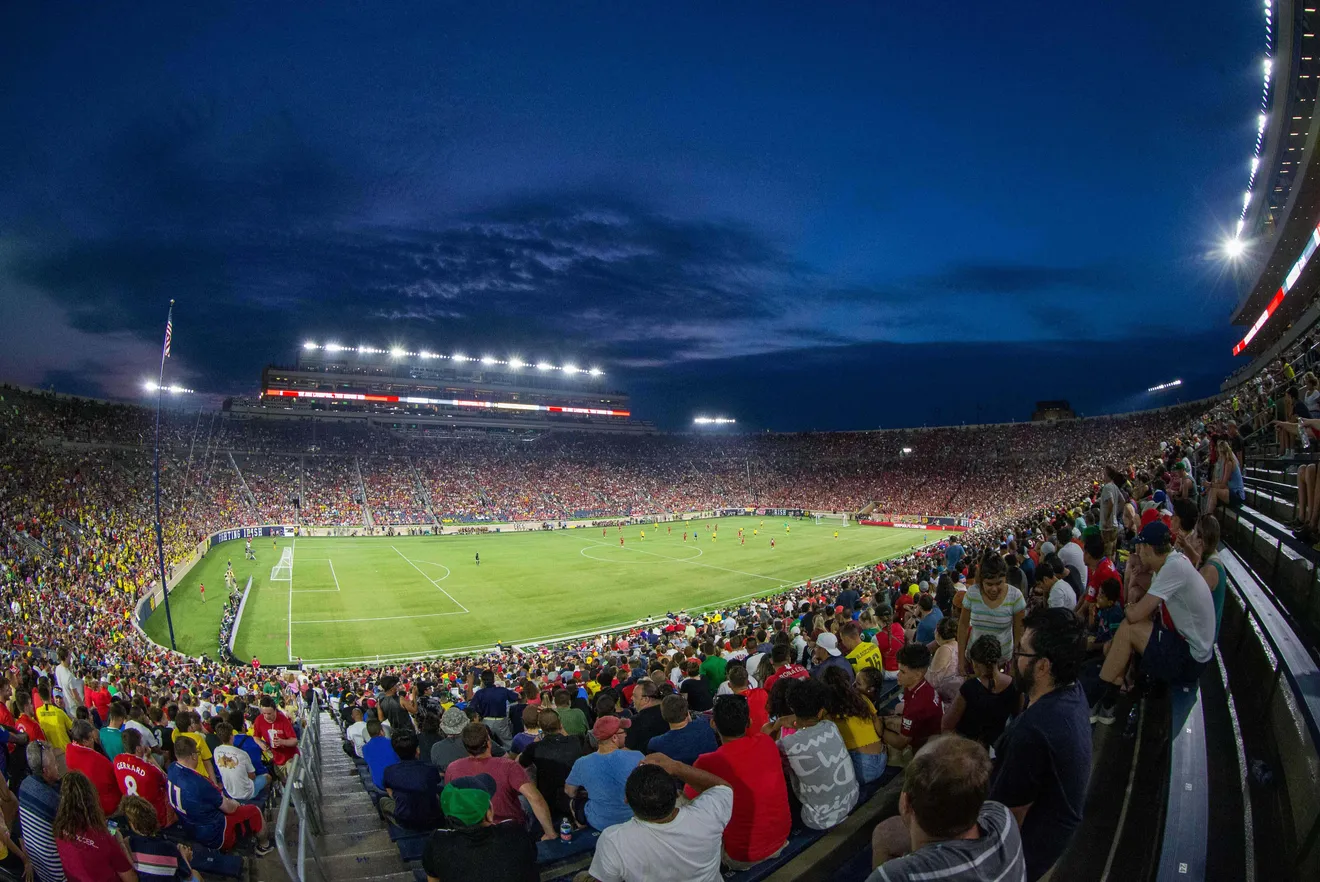
In July 2019, Notre Dame Stadium hosted the first competitive soccer match in its 90-year history when Liverpool F.C. faced Borussia Dortmund in an international preseason friendly. To meet the expectations of two of the world’s elite professional clubs, the stadium needed something it had not had since 2014: real grass. Bush Sports Turf was contracted to convert the artificial-turf venue into a tournament-grade natural-grass pitch, support the international match, and return the stadium to football-ready condition — all on a roughly seven-day clock.
Project Overview
Project Name
Notre Dame Stadium Natural-Grass Conversion — Liverpool F.C. vs. Borussia Dortmund
Client Background
Notre Dame Stadium opened in 1930 and is one of college football’s most iconic venues. The stadium transitioned to an artificial-turf playing surface in 2014. As part of the $400 million Campus Crossroads expansion, the University of Notre Dame established a strategic priority of broadening the stadium’s use beyond football. In the year leading up to this project, the venue had hosted more than 700,000 guests across events including a Garth Brooks concert in October 2018 and the 2019 NHL Winter Classic between the Boston Bruins and Chicago Blackhawks.
Objective
Deliver a professional-grade natural-grass playing surface acceptable to two top-tier European clubs, fully protect the underlying artificial turf during install, match day, and removal, and restore the stadium to football operations within days of the match — all while supporting Notre Dame’s broader Campus Crossroads goal of attracting more high-profile non-football events.
Scope
End-to-end pitch conversion. This included refrigerated sod logistics, protective underlayment installation, full-field big-roll natural sod installation, mechanical compaction and seaming, mowing, soccer-line painting, ongoing irrigation through match week (including in-match watering at halftime), post-event sod removal and composting, and full restoration of the artificial turf below.
Key Details
This was the first-ever competitive soccer match at Notre Dame Stadium. Sod was sourced and shipped in refrigerated trucks from New Jersey, with each big roll weighing 2,000 pounds. The conversion was executed under demanding mid-summer heat. Bush Sports Turf simultaneously delivered a parallel conversion at NRG Stadium in Houston that same week — a real-world demonstration of the firm’s operational capacity for high-stakes, time-compressed events at multiple major venues at once.
- Timeline: One week on site (July 15 – July 21, 2019); contract awarded April 2019
- Specialized Equipment: Refrigerated long-haul trucks for sod transport, forklifts for offloading 2,000-pound big rolls, a big-roll installation machine, a follow-on compaction and flattening machine, mowers, field-painting equipment, irrigation and watering equipment, and hand tools for final trim work.
- Project value: Confidential per client agreement
Construction Strategy and Implementation
Concept and Vision
The vision for this project was straightforward but unusually demanding: give Liverpool, Borussia Dortmund, and the international soccer fans in attendance a playing experience indistinguishable from a permanent professional soccer venue — on a stadium floor that had been a football field a few days earlier and would be a football field again a few days later. Bush Sports Turf’s approach treated the artificial turf below as untouchable; nothing in the conversion process could be allowed to compromise it. That principle drove every choice, from the protective fabric layer placed beneath the sod to the way the big-roll natural grass was seamed, compacted, and watered. The defining features of the project were a protective underlayment that prevented soil migration into the artificial turf, full-field 2,000-pound big-roll natural sod for a fast and consistent ball roll, and a fully reversible installation plan engineered before the first roll arrived in South Bend.
Project Philosophy & Key Features
Bush Sports Turf has built its reputation on temporary natural-grass conversions at marquee venues, including the 2014 Michigan Stadium conversion for the Real Madrid vs. Manchester United International Champions Cup match, which served as a direct reference blueprint for the Notre Dame project. The philosophy that anchors these conversions is simple: no shortcuts on playing-surface quality, no compromises on the host venue. Athletes get a true professional pitch; the stadium gets back exactly what it had before. That dual obligation — to the players on the field and to the facility hosting the event — shapes the firm’s process discipline, its equipment investment, and the way it sequences install, maintenance, and removal across a tight project window.

Execution
Phase 1 — Mobilization and Logistics (April – July 15, 2019)
After the project was announced in late April, the Bush Sports Turf team coordinated sod sourcing, refrigerated long-haul trucking from New Jersey, equipment staging, and a joint operational plan with Notre Dame’s grounds, maintenance, and facility crews and with Fenway Sports Group, the event owner and Liverpool F.C.’s parent organization. Sod was sourced and transported under refrigeration to preserve playing quality on the long haul to South Bend.
Phase 2 — Installation (July 15 – July 17, 2019)
Refrigerated trucks began rolling into Notre Dame Stadium just after noon on Monday, July 15. A protective fabric layer was first installed across the stadium’s artificial turf to prevent any soil from the natural sod from migrating into the synthetic surface beneath. Forklifts then offloaded the 2,000-pound big rolls; an installation machine laid them across the field; and a follow-on machine pushed and flattened each roll to ensure a tight, seamless fit. Crews worked behind the equipment to make hand trims and to water the freshly laid surface. Installation was complete by Wednesday, July 17, despite challenging mid-summer heat that owner Steve Bush noted made the install harder than ideal conditions.
Phase 3 — Pitch Preparation (July 17 – July 19, 2019)
Once installed, the field was rolled to verify a true, even playing surface, mowed to playing height, and painted with regulation soccer markings. The Bush Sports Turf team executed a watering schedule designed to deliver a fast, plush pitch by kickoff, and continued that schedule into match day.
Phase 4 — Match Day (July 19, 2019)
Liverpool F.C. and Borussia Dortmund played the first competitive soccer match in Notre Dame Stadium’s 90-year history before an announced attendance of 40,361. The Bush Sports Turf grounds team managed the surface throughout the event, including a deliberate in-match watering at the end of the first half to maintain ball-roll speed across the second 45 minutes.
Phase 5 — Removal and Restoration (July 20 – July 21, 2019)
Within hours of the final whistle, crews began lifting the sod. The natural grass was removed and composted rather than landfilled. The protective underlayment was taken up, and the artificial turf below was inspected and restored. By Sunday, July 21, the stadium was back to its football configuration, ready for the next event on Notre Dame’s calendar.

Results and Acknowledgments
The project delivered on its core obligations: a professional-grade natural-grass surface for the Liverpool F.C. vs. Borussia Dortmund friendly, complete protection of the underlying artificial turf throughout install, match, and removal, and on-time restoration of the venue inside the one-week project window. The match itself stood as the first competitive soccer match in Notre Dame Stadium’s 90-year history, drawing an announced attendance of 40,361 and contributing meaningfully to Notre Dame’s Campus Crossroads strategy of expanding the stadium’s role beyond college football. The same Bush Sports Turf operation was simultaneously executing a parallel natural-grass conversion at NRG Stadium in Houston that week, underscoring the company’s proven capacity to deliver multiple major-venue conversions on overlapping timelines.
Bush Sports Turf gratefully acknowledges the partnership of the University of Notre Dame’s grounds, maintenance, facility, and events teams, including the leadership of Micki Kidder, Vice President for University Enterprises and Events, and Lee Sicinski, Associate Vice President of Events. Thanks also to Fenway Sports Group as event owner, and to the Liverpool F.C. and Borussia Dortmund operations teams for their collaboration on the ground. The project methodology drew directly on Bush Sports Turf’s earlier natural-grass conversion at Michigan Stadium and reflects a multi-decade body of work delivering temporary, professional-grade pitches at premier U.S. venues.

Challenge vs. Solution

One Week. Two Top European Clubs. Zero Margin for Error.
Notre Dame Stadium had not seen a natural-grass surface since 2014, but Liverpool F.C. and Borussia Dortmund expected a Premier League-grade pitch. Bush Sports Turf had roughly seven days to install a tournament-quality natural-grass overlay, support an internationally televised match, and return the venue to football-ready condition — all without compromising the artificial turf below.

First-ever competitive soccer match in the stadium’s 90-year history
Roughly 7-day on-site window covering install, match day, and full removal
Two top European clubs expecting a Premier League-grade natural-grass pitch
Underlying 2014 artificial turf had to be fully protected — no compromise allowed
Refrigerated long-haul sod logistics from New Jersey to South Bend, Indiana
Mid-summer Indiana heat made install conditions less than ideal
A Reversible Pitch, Engineered for Pro-Level Play.
Bush Sports Turf delivered a fully reversible natural-grass overlay system engineered to meet professional soccer standards while completely protecting Notre Dame Stadium’s underlying artificial turf — installed, played, and removed inside one project week.

Protective fabric underlayment prevented soil migration into artificial turf
Full-field 2,000-lb big-roll natural sod for fast, consistent ball roll
Refrigerated long-haul transport from New Jersey to preserve sod quality
Mechanical compaction and seaming for tight, professional-grade joints
In-match irrigation at halftime to maintain ball-roll speed second half
Full sod removal and composting; venue restored to football by day 7
The Work, Up Close


TESTIMONIALS
From The Client


Trevor Vance
Recent Projects